Author: Jorge Moreno
A team of researchers has reported a very rare case: a patient who developed Creutzfeldt-Jakob disease (CJD) almost 48 years after receiving treatment with human growth hormone from cadavers during childhood. CJD is a prion disease caused by abnormal proteins called prions, which damage the brain and cause severe neurological symptoms such as loss of balance, tremors, difficulty speaking and, ultimately, accelerated cognitive decline.
When the disease appears as a result of medical intervention, i.e., transmitted through surgical instruments or other medical procedures in which prions are accidentally introduced from one patient to another, it is known as an iatrogenic disease. In this case, transmission comes from repeated injections of growth hormone to treat growth problems. In the United States, some 7,700 people received this treatment with growth hormone from cadavers (the hormone was extracted from the pituitary glands of deceased individuals) between the 1960s and 1980s, before the risk involved was discovered and it was replaced by synthetic hormone in 1985. Since then, 36 cases in the United States and 254 worldwide have been identified in connection with this treatment.
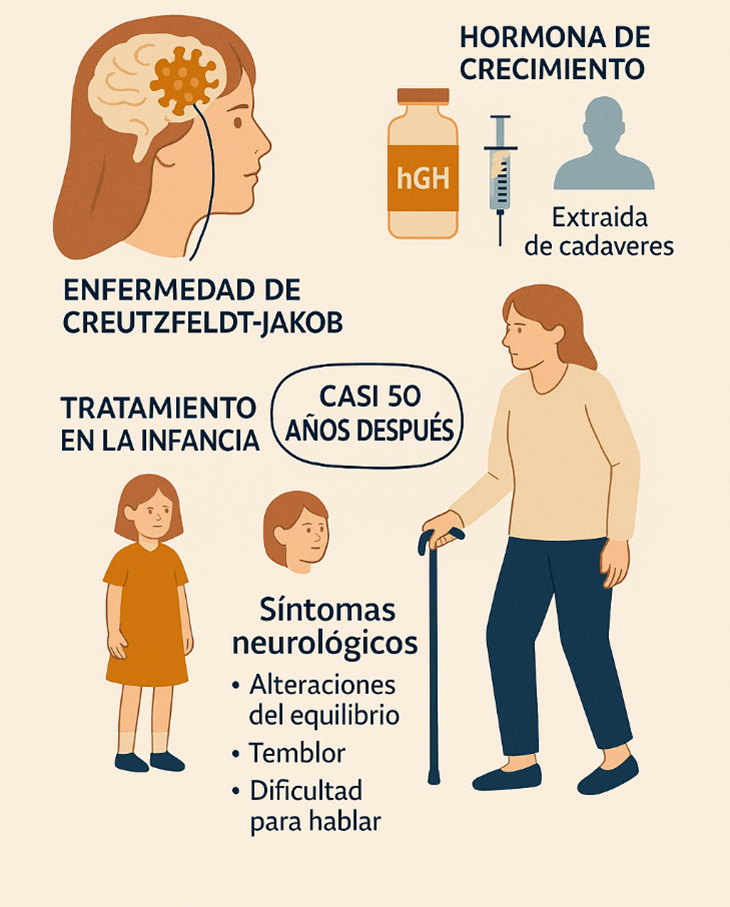
A key point is that in 1977, a new purification method was introduced to extract the hormone, which fortuitously drastically reduced the presence of prions. Thanks to this improvement, no cases have been reported in people who received the hormone exclusively after that date, demonstrating the effectiveness of the change. Experts believe that the contamination was very low and random, but sufficient to cause the disease in some patients decades later. This case is particularly striking because it shows an extremely long incubation period: more than 48 years. This means that, although the outbreak has been greatly reduced, so that cases of iatrogenic CJD resulting from this treatment are rarely diagnosed today, cases may still occur in people treated before 1977, even after several decades. Therefore, doctors recommend considering this possibility if someone has neurological symptoms and has received this type of treatment in the past.
As a final note, it should be clarified that today, the growth hormone used in treatments is synthetic and completely safe, with no risk of prion transmission. Advances in purification and production have completely eliminated this danger for more than 40 years.
Here you can access the article describing this exceptional case.
 English (UK)
  Español
  Français