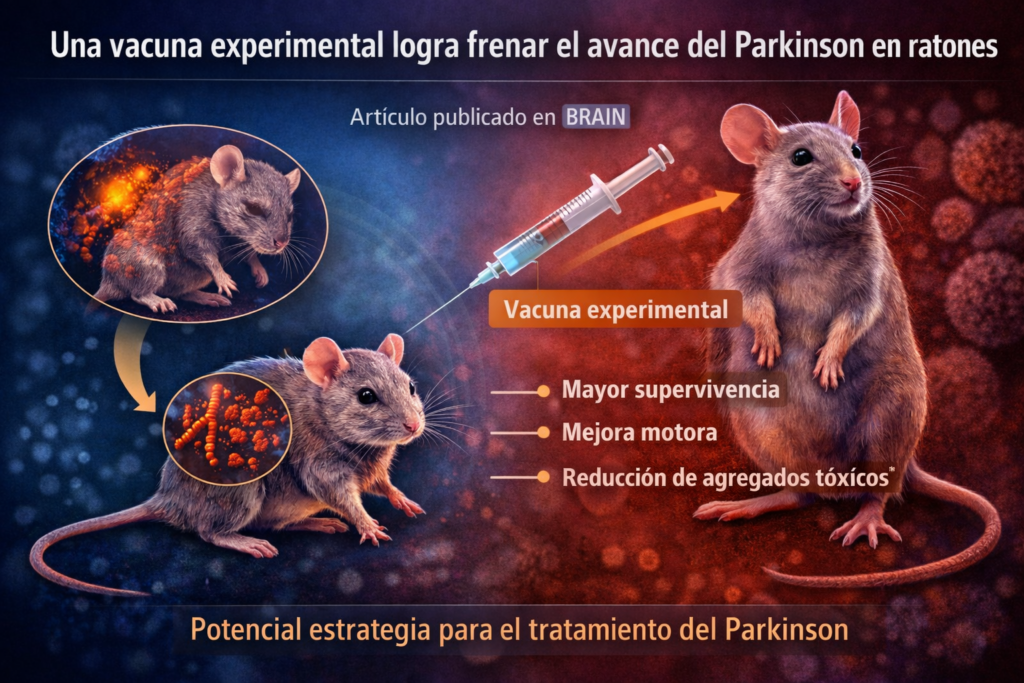
An international team of researchers has taken a promising step towards the prevention and treatment of Parkinson's and other related neurodegenerative diseases by developing an experimental vaccine capable of significantly delaying the onset of symptoms in animal models (mice that partially reproduce the human disease), as well as improving their mobility and increasing their survival by up to 42%. Consequently, this study, published in the scientific journal Brain, opens the door to new strategies for combating these diseases before they cause irreversible damage to the brain.
What causes Parkinson's disease?
Parkinson's disease is a progressive neurodegenerative disorder associated with the abnormal accumulation of a protein called α-synuclein. In healthy individuals, this protein performs necessary functions in neurons. However, with age or due to genetic factors, it can begin to fold incorrectly, i.e. it changes its three-dimensional structure, grouping together in toxic structures (known as amyloid fibrils) that multiply and spread throughout the nervous system, damaging neurons and causing motor and cognitive problems.
However, despite knowing the causes of this and other similar diseases (such as Lewy body dementia and multiple system atrophy), there is still no cure, and the treatments available only alleviate the symptoms but do not halt the progression of the disease.
An innovative idea: a “copy” to train the defences
One of the major obstacles to treating Parkinson's disease is that α-synuclein is a protein produced naturally by the body. As a result, the immune system does not identify it as a threat, even when it takes on its toxic form. This has hindered the development of vaccines for years, as vaccines are based precisely on training the immune system to recognise substances that are foreign or alien to the body.
To solve this problem, researchers have used a harmless protein from a fungus (called HET-s) as a “scaffold” to design artificial fibrils that mimic the three-dimensional shape of the toxic fibrils generated by α-synuclein in the course of Parkinson's disease. By introducing these “copies” (hybrids with part of the fungal protein and specific sections of α-synuclein) into the body, the immune system learns to recognise and specifically attack these toxic forms, generating specific antibodies that do not interfere with the healthy protein.
Encouraging results in mice
The vaccine was tested on genetically modified mice that develop a disease similar to human Parkinson's. After vaccination, the animals were exposed to toxic α-synuclein fibrils to trigger the disease. The results obtained were very interesting as they demonstrated:
- Increased survival: Vaccinated mice lived up to 42% longer than unvaccinated mice after being exposed to the disease.
- Protection against motor and neurological deterioration: Vaccinated animals maintained their muscle strength and mobility better and did not suffer the weight loss characteristic of advanced Parkinson's disease.
- Effectiveness in humans: The antibodies generated by vaccinated mice were able to recognise and bind to toxic proteins present in brain samples from actual human patients with Parkinson's disease and related pathologies, indicating that the strategy could be transferable to humans.
Towards a future without Parkinson's?
Although this research is still in its early stages, the results suggest that a vaccine of this type could be used preventively in the future, especially in people at high risk of developing Parkinson's, such as those with genetic mutations or sleep disorders that precede the disease.
According to the authors, if the vaccine were equally effective in humans and administered in the very early stages of the disease, it could delay the onset of Parkinson's from age 65 to age 92. Given that average life expectancy is usually lower, this could mean the virtual eradication of certain types of Parkinson's.
However, it is important to emphasise that these results have only been obtained in animals. Further studies are still needed to confirm safety, duration of protection and efficacy in humans. It will also be necessary to determine when it would be most appropriate to administer the vaccine and whether it could be useful once the disease has already begun and there is significant neuronal damage.
Even so, this work represents an important advance in the fight against Parkinson's disease and demonstrates that ‘attacking’ misfolded or toxic proteins through vaccines could be a promising strategy, not only for this disease, but also for other neurodegenerative pathologies such as Alzheimer's disease or type II diabetes.
You can access the original article (in English) at this link.
 English (UK)
  Español
  Français