Author: Cristina Sampedro Torres-Quevedo
We are used to talking about amyloid proteins in relation to diseases, whether they be the aggregates associated with prion diseases, Alzheimer’s or Parkinson’s, amongst others. When we talk about amyloid aggregates, we are talking about disease, but this may be about to change. In bacteria, it has long been known that this correlation is not absolute and that there are proteins capable of forming amyloids which aggregate and alter their function as a biological adaptation to a stimulus; however, this phenomenon had not previously been described in other living organisms. Recently, researchers from a university in Hong Kong, in collaboration with Spanish researchers from the CSIC, have described a protein that forms functional amyloids linked to long-term memory in fruit flies.
In a previous paper, the same authors described how, in response to the Funes protein (a nod to the character in Borges’s short story, ‘Funes the Memorious’, who was unable to forget anything after suffering an accident), the Orb2 protein changed its structure, aggregated and shifted from an inhibitory state to one in which it promoted the expression of genes involved in maintaining long-term memory in fruit flies.
It is this second protein that takes centre stage in the authors’ current article, in which they seek to understand how its structure changes and the effect this has on the flies’ memory throughout their lives. The researchers have found that this protein can form different types of aggregates in flies of all ages; however, the proportion of each type of aggregate it forms changes with age. Younger flies predominantly exhibit aggregates of a specific type (3H, formed by three linked Orb2 molecules), whilst as they age, the proportion of these aggregates changes; although those formed by three Orb2 molecules do not disappear, their frequency does decrease compared with those formed by two, four, six and even up to eight Orb2 molecules. As well as being larger, the aggregates that appear with age are more resistant to disaggregation, a characteristic that is more similar to aggregates associated with pathology than to those that have a physiological function, as this function often requires them to be able to transition from an aggregated state to a free state with relative ease.
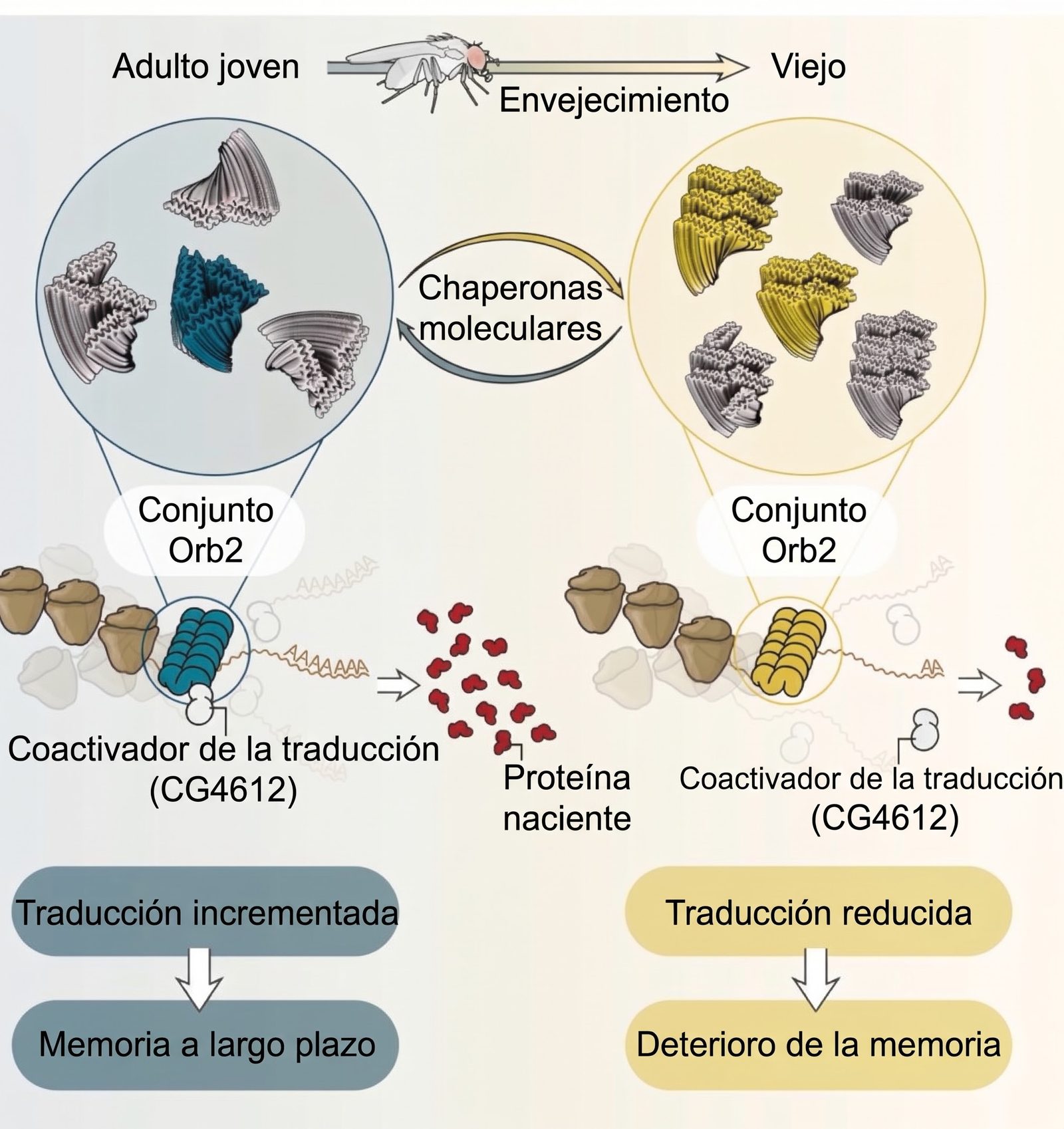
The authors explain that, of all the aggregates capable of forming the Orb2 protein, only those consisting of three Orb2 molecules promote gene expression linked to the formation and maintenance of memory. The other aggregates lose the ability to activate these genes, and this is what causes memory to deteriorate with age.
Furthermore, when the researchers added the Funes protein to older flies, their Orb2 protein was able to revert to the aggregate types typical of youth, and the flies’ memory improved. Conversely, if they added a protein with the opposite function to Funes – CG6693 – to young flies, their memory deteriorated. The conclusion is that age influences the types of Orb2 present in the flies’ brains, and it is this which causes their long-term memory to be impaired.
And what about humans? Does the Orb2 protein exist? A protein analogous to Orb2 has indeed been described in mammals, but it is not known whether it forms this type of functional amyloid. The authors also point out that mutations in the human memory-inhibiting protein CG6693 have been linked to deficits in attention and executive function in patients with schizophrenia. Therefore, this research in fruit flies could be relevant to the study of memory in organisms with more complex brain functions.
This study could mark the beginning of a paradigm shift, in which amyloids are no longer regarded merely as toxic and disease-causing in animal species, but are also recognised as having important functions in the normal operation of certain cellular pathways. Consequently, the distinction between whether an amyloid is functional or not may be more closely related to the conformations it adopts and its compatibility with normal cellular function than to its mere presence.
Access the original research article (in English) here.




 English (UK)
 Español
 Français