Author: Inés Xanco
Until now, studies based on cell cultures (live neurons grown in the laboratory) had not managed to reliably reproduce human prion infection, meaning it was not possible to study how the prion multiplies and is transmitted under conditions similar to those found in affected patients. As a result, research has relied mainly on animal models, particularly genetically modified mice, which, although they better replicate the disease, involve lengthy and costly experiments that must be carried out in high-biosafety facilities.
In addition to animal models, there are techniques carried out in test tubes, such as RT-QuIC (Real-Time Quaking-Induced Conversion, real-time quaking-induced conversion), which are capable of detecting the presence of abnormal prion proteins even in very small quantities. However, whilst these tests detect the ability of prions to induce or cause the misfolding of other proteins, they do not allow us to determine with certainty whether those prions retain infectious capacity, nor do they allow us to study the interactions between prions and neurons. Therefore, although they are very useful tools for detecting prions, they do not allow us to determine whether a treatment would actually eliminate infectious prions in more complex environments such as animal models.
In the case of prions that affect animals, models based on cell cultures have long since been developed, such as the Scrapie Cell Assay (SCA) (from the English, ‘em’ and ‘scrapie’ ), which enable the infectious capacity of prions affecting mice or sheep, amongst others, to be studied and quantified more rapidly than animal bioassays. However, until now, it had not been possible to develop an equivalent system for human prions, which has limited the study of their biology and the mechanisms responsible for the disease.
This study, published in the prestigious journal PNAS and carried out by researchers at the Medical Research Council’s Prion Unit at University College London, explains how the EKV cell line was developed – a new humanised cell culture model (mouse cells that produce the human prion protein) capable of propagating infectious prions of sporadic Creutzfeldt-Jakob disease (sCJD) in dividing cells. The prions generated in these cultured neurons were able to transmit the disease to transgenic mice expressing the human prion protein and reproduced the same characteristics observed when the animals were directly inoculated with brain tissue from sCJD patients, indicating that this cell model faithfully reproduces some of the events that occur in patients.
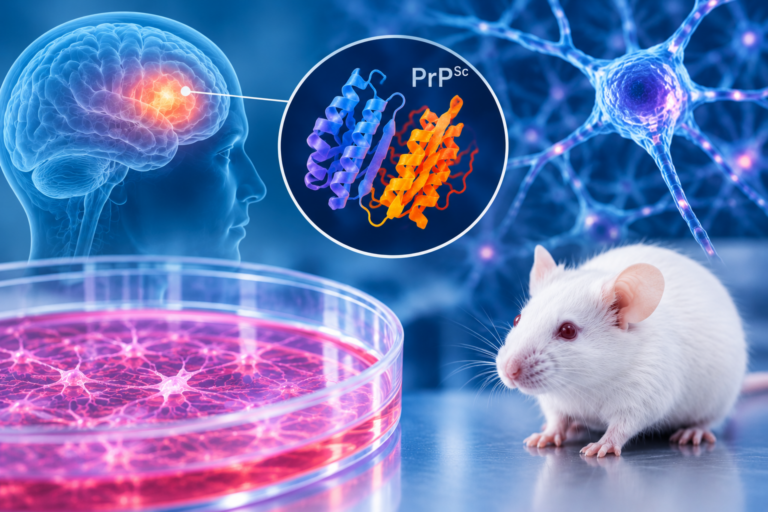
To develop this model, the researchers introduced the human prion protein into a mouse neuron cell line previously known for its ability to propagate animal prions. Through a process of selecting from thousands of cell clones, they identified those cells with the greatest capacity to sustain a stable human prion infection.
Using this line of cultured neurons, they developed a new assay, known as the Human Prion Assay (HPA), which enables the propagation of human prions to be studied in a reproducible manner comparable to mouse bioassays, but approximately ten times faster than these. For the first time, this new cellular model makes it possible to study, in a simpler and more reproducible way, how human prions multiply in their natural environment – the neurons – to measure their infectivity and to test potential treatments against them. In fact, this research group demonstrated that prions could be eliminated from infected cells following treatment with the antibody ICSM18, a compound that had previously shown efficacy against animal prions in cell cultures. This result validates this model as a tool for identifying and evaluating potential treatments for human prion diseases, directly in an environment similar to that of the brains of affected individuals.
Despite this significant advance, the authors acknowledge that the model still has some limitations. For example, it is only able to propagate certain subtypes of sporadic Creutzfeldt-Jakob disease; the authors therefore believe it will be necessary to develop new cell lines capable of reproducing the full diversity of human prions. Nevertheless, this work represents an important step, as it provides, for the first time, a robust cellular platform for specifically studying the biology of human prions, gaining a better understanding of the mechanisms of the disease and accelerating the search for effective treatments.
Access the original research article (in English) here.



 English (UK)
 Español
 Français