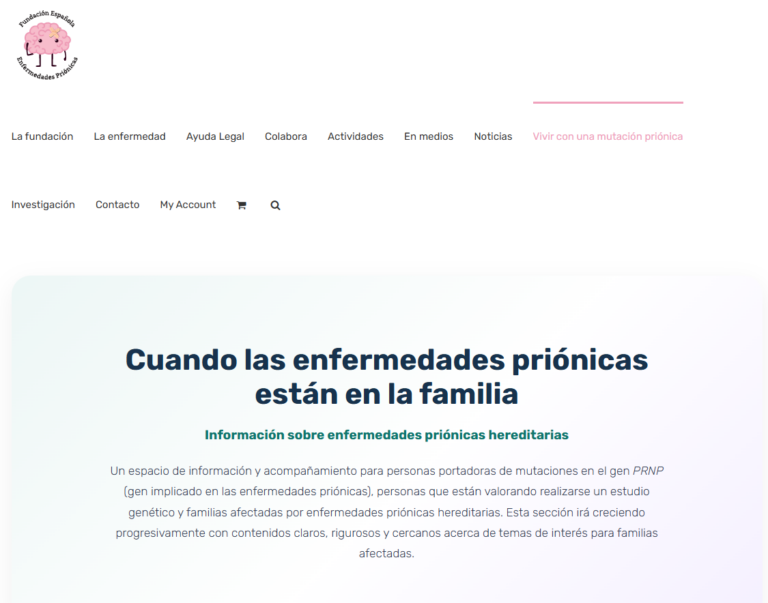
As a result of collaboration between researchers involved in the Interreg-POCTEFA NeuroCoop project and the Spanish Prion Disease Foundation, a new section has just been launched on the Foundation’s website: ‘Living with a prion mutation’.
This new section has been created as an information and support resource for people carrying mutations in the PRNP gene, at-risk relatives and families affected by hereditary prion diseases, such as genetic Creutzfeldt-Jakob disease (genetic CJD) or fatal familial insomnia (FFI). A new section has just been launched on the foundation’s website.
Prion diseases can have various causes. Some are acquired, resulting from infection with prion-contaminated tissue, widely known due to the mad cow disease epidemic, but now virtually eradicated; sporadic or idiopathic, which are of unknown cause, affect approximately 1–2 people per million per year and account for 85% of prion diseases currently diagnosed; and genetic or familial, resulting from a mutation in the PRNP gene, accounting for the remaining 15% of cases. Unlike sporadic cases, in which completely healthy individuals with no known genetic abnormalities develop the disease, in genetic cases—and particularly in the most common genetic forms such as genetic CJD and FFI, which have a penetrance of nearly 100%—the onset of the disease can be predicted through genetic testing. Although there are currently no treatments available and the age of onset of symptoms cannot be determined, the possibility of anticipating the disease’s development through genetic testing leads to a different approach to these conditions, both from a medical perspective and from the perspective of those affected.
Among other things, knowing that a disease runs in the family and that each member has a certain probability of carrying the causative mutation raises many questions and can affect how one views the future, makes family decisions or copes with uncertainty. For this reason, and to support the information and support work carried out by the Spanish Foundation for Prion Diseases, informative resources based on rigorous scientific studies have been developed in collaboration with NeuroCoop’s partners, which will be published on its website.
This joint initiative reflects the collaborative spirit and commitment to serving those affected by neurodegenerative diseases that characterise the NeuroCoop project and its participants, whose aim of establishing a cross-border cooperation network for the study and treatment of these diseases is taking shape through concrete activities and resources. Therefore, at NeuroCoop, we would like to invite all those interested to visit the website of the Spanish Prion Diseases Foundation and join our network, which is growing every day.
 English (UK)
  Español
  Français