
La Fundación Española de Enfermedades priónicas inaugura la sección ‘Vivir con una mutación priónica’ en colaboración con NeuroCoop
Fruto de la colaboración entre los investigadores que forman parte del proyecto NeuroCoop, de Interreg-POCTEFA, y la Fundación Española de Enfermedades Priónicas, se acaba de inaugurar una nueva sección en la web de la Fundación: “Vivir con una mutación priónica”. Esta nueva sección nace como un recurso informativo y de acompañamiento dirigido a personas portadoras […]
Síntomas de pacientes con enfermedades priónicas de rápida progresión que podrían beneficiarse de cuidados paliativos

Autor: Hasier Eraña La Organización Mundial de la Salud (OMS) define los cuidados paliativos como el enfoque o respuesta organizada que tiene como objetivo mejorar la calidad de vida de pacientes y familias que se enfrentan a los problemas asociados con enfermedades que amenazan la vida. Esto se logra mediante la prevención y alivio del […]
Efavirenz, an existing drug, is moving into a clinical trial for Creutzfeldt-Jakob disease
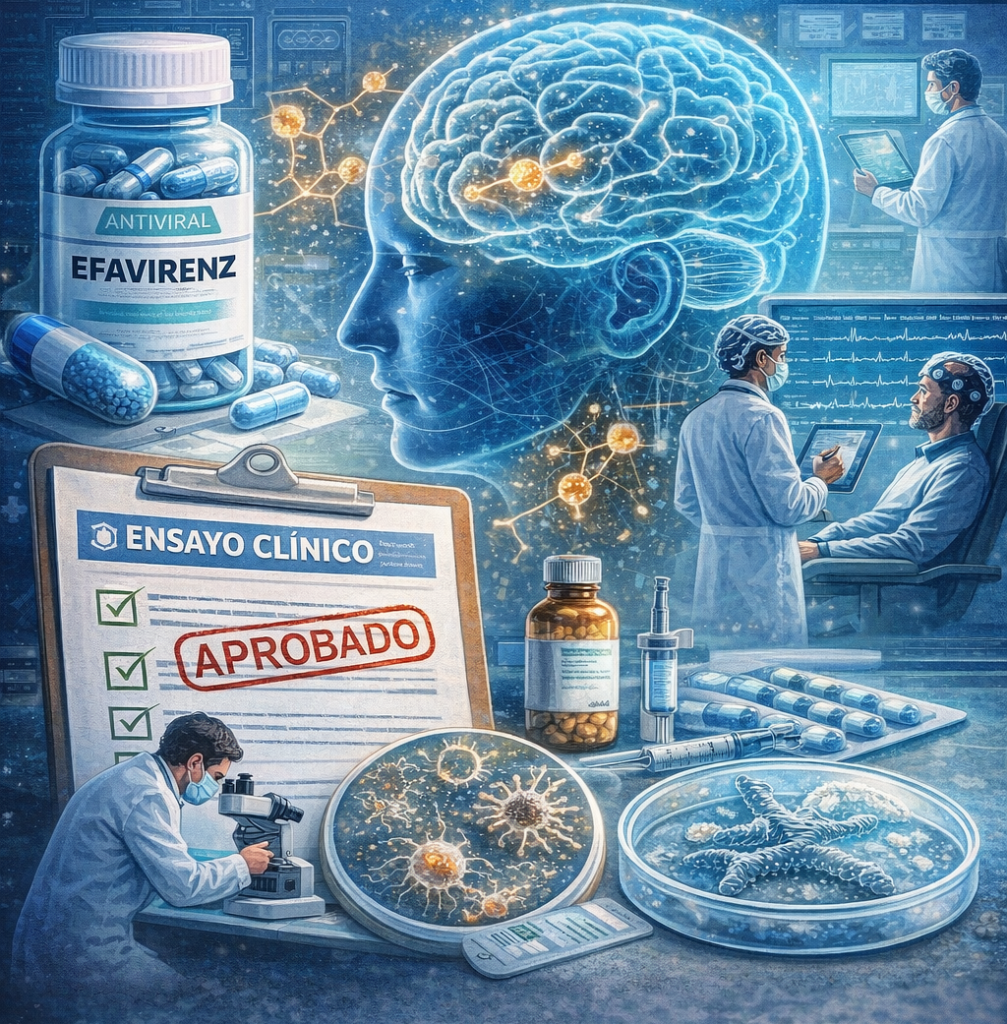
Efavirenz, un fármaco ya conocido, da el salto a un ensayo clínico en enfermedad de Creutzfeldt-Jakob Un ensayo clínico registrado en ClinicalTrials.gov está evaluando si el efavirenz, un medicamento utilizado desde hace años en el tratamiento del VIH, puede aportar beneficio en la enfermedad de Creutzfeldt-Jakob (ECJ). Según el registro, que recoge todos los ensayos […]
Biosafety in laboratories working with prion diseases: a European study examines the current situation

Autor: Sara Caballero Un estudio reciente coordinado por el Laboratorio Europeo de Referencia para las Encefalopatías Espongiformes Transmisibles (EURL-TSE) ha analizado cómo se aplican las medidas de bioseguridad en los laboratorios europeos que trabajan con enfermedades priónicas, como la enfermedad de Creutzfeldt-Jakob (ECJ), la encefalopatía espongiforme bovina (EEB) y otras enfermedades relacionadas. El trabajo, basado […]
The L108I polymorphism in mouse prion protein drives spontaneous disease and enhances transmission of atypical and classical prion strains
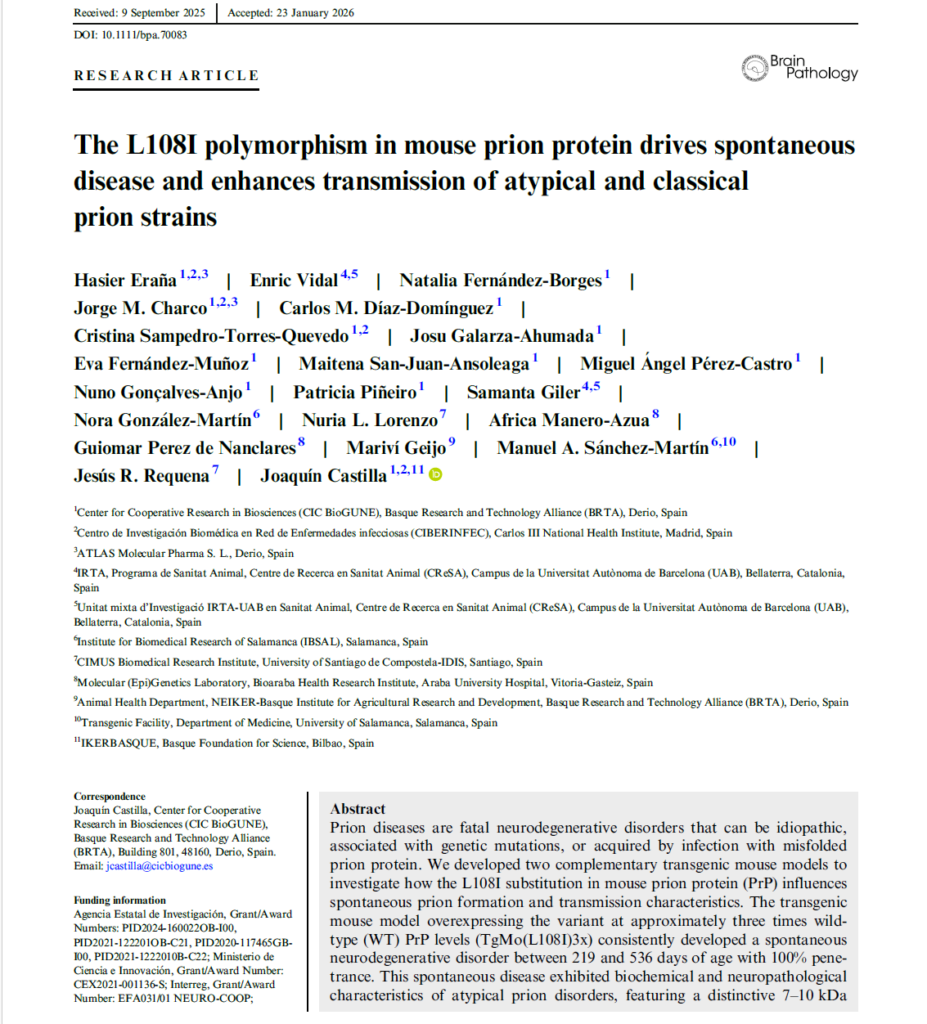
The L108I polymorphism in mouse prion protein drives spontaneous disease and enhances transmission of atypical and classical prion strains Eraña H, Vidal E, Fernández-Borges N, Charco JM, Díaz-Domínguez CM, Sampedro-Torres-Quevedo C, Galarza-Ahumada J, Fernández-Muñoz E, San-Juan-Ansoleaga M, Pérez-Castro MÁ, Gonçalves-Anjo N, Piñeiro P, Giler S, González-Martín N, Lorenzo NL, Manero-Azua A, Perez de Nanclares G, […]
Optimisation of prion disease detection in tear secretions and cerebrospinal fluid.
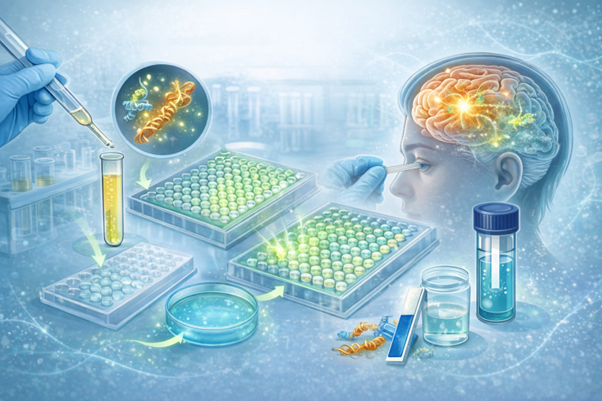
La detección inequívoca de enfermedades priónicas en pacientes es un desafío al que todavía nos enfrentamos, ya que en muchos casos el diagnóstico se hace por la sintomatología que presentan estos pacientes, y no detectando marcadores únicos de la enfermedad hasta que se realiza una autopsia. La aparición de la técnica conocida como RT-QuIC (de […]
Genetic Creutzfeldt-Jakob disease caused by the E200K mutation: a disease with many faces
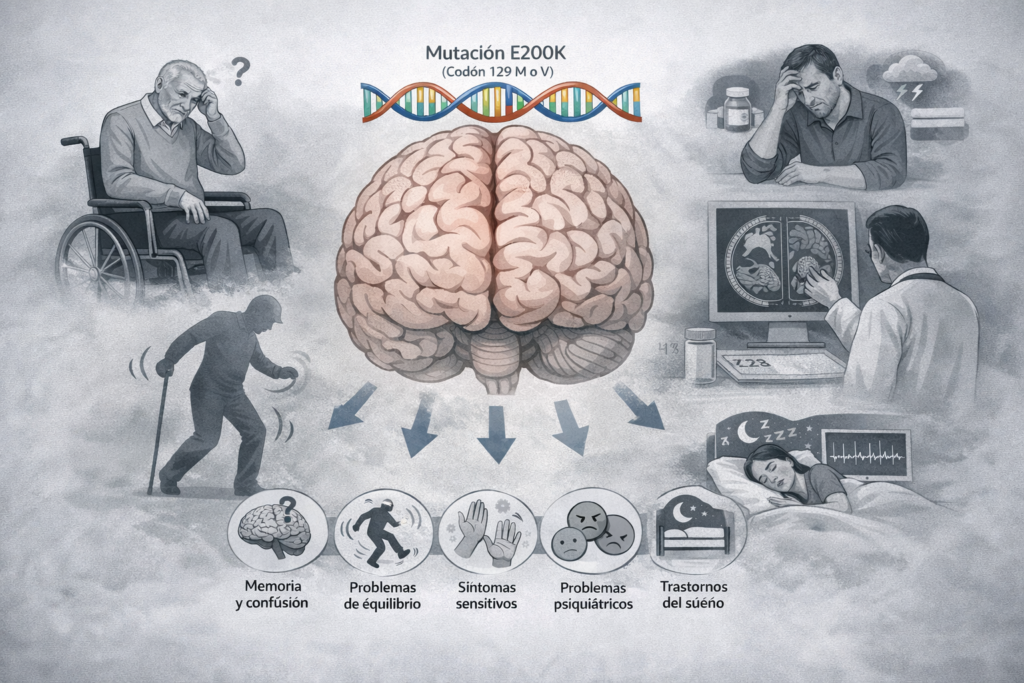
Autor: Hasier Eraña Un estudio internacional recientemente publicado en la revista científica Acta Neuropathologica (puede acceder al artículo original, en inglés, aquí) ha analizado en profundidad la enfermedad de Creutzfeldt-Jakob genética (ECJ genética) causada por la mutación E200K, la forma hereditaria más frecuente de las enfermedades priónicas humanas. Se trata del mayor estudio realizado hasta […]
Rapid generation of prion disease models using AAV-delivered PrP variants in knockout mice
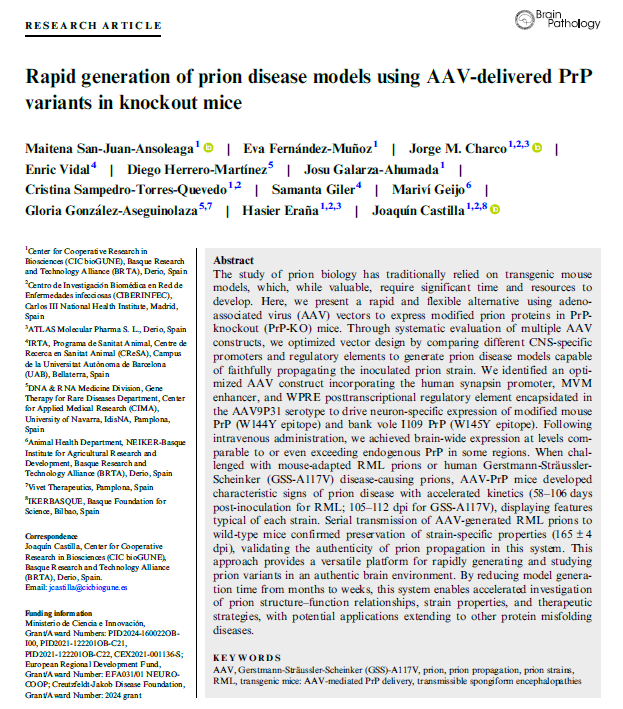
Rapid generation of prion disease models using AAV-delivered PrP variants in knockout mice
Overexpression of bank vole PrP(I109) in mice induces a spontaneous atypical prion disease with sex-dependent onset, early NfL elevation, and universal prion strain permissiveness
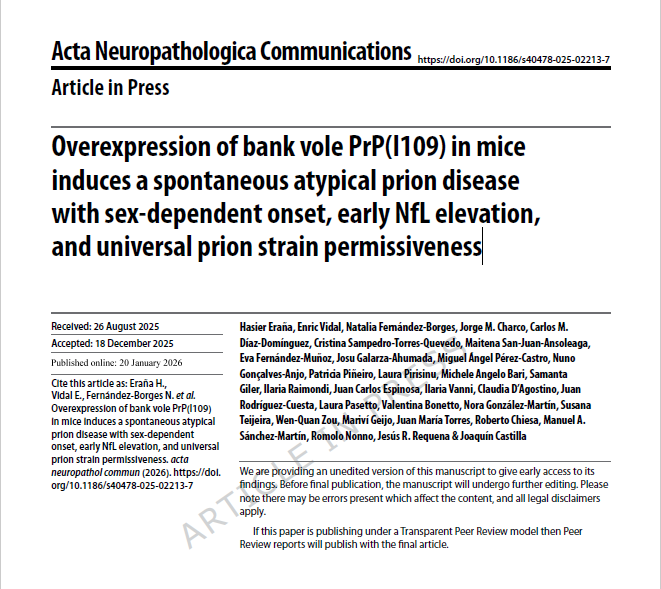
Overexpression of bank vole PrP(I109) in mice induces a spontaneous atypical prion disease with sex-dependent onset, early NfL elevation, and universal prion strain permissiveness
Advancing prion diagnostics: full-length human E200K RT-QuIC substrate facilitates prion detection in tear fluid and improves sensitivity in cerebrospinal fluid
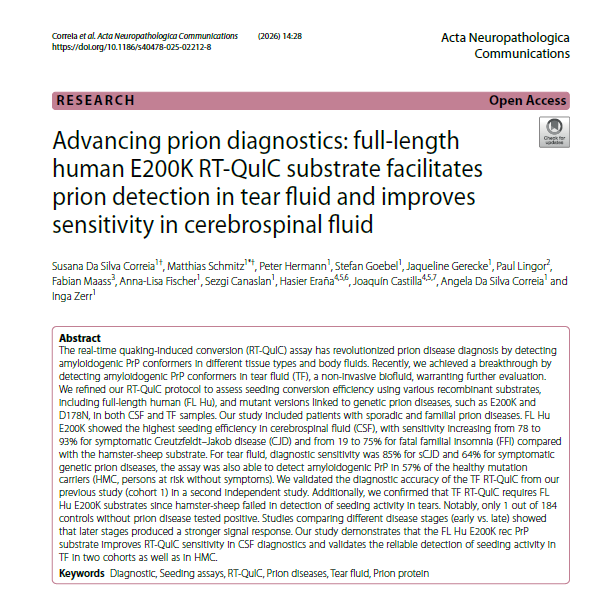
Advancing prion diagnostics: full-length human E200K RT-QuIC substrate facilitates prion detection in tear fluid and improves sensitivity in cerebrospinal fluid
 English (UK)
  Español
  Français